

Meetings generate a huge amount of information. Decisions get made, priorities shift, risks surface, and intent becomes clearer. Yet for many teams, that information never translates into action.
There’s an ongoing debate about whether people are in too many meetings, but the problem isn’t simply the volume of meetings. It’s what happens around them. Preparation is rushed, context is fragmented, and follow-ups are often delayed or inconsistent. The cost isn’t just time spent talking. It’s the momentum that gets lost afterward.
Just like AI has revolutionized coding and copywriting, AI is going to revolutionize our meeting workflow too. Not by replacing meetings or simply transcribing them, but by acting as a continuity layer across conversations. AI makes it possible to surface the right context before a meeting, capture what actually matters during it, and turn conversations into usable outputs afterward. “Meetings are no longer isolated events. They become crucial inputs for ongoing work.
What follows explores how AI enables that shift. Not which tools to buy, and not how many meetings teams should have, but what becomes possible once AI is applied across the full meeting lifecycle.
Meetings as information systems, not calendar events
It's easy to think of meetings as moments in time. A block on the calendar. A call that starts and ends. Something you attend, then move on from.
In practice, meetings function more like information systems. They generate decisions, clarify intent, surface risks, and reveal how priorities are changing. Much of the most important work information doesn't appear first in documents or task trackers. It appears in conversation.
The problem is that most organizations still treat meetings as disposable. Once the call ends, the information created inside it is easily lost. It lives in partial notes, personal memory, or long transcripts that are rarely revisited. Context resets from one conversation to the next, even when the topics are deeply connected.
This is where AI creates a meaningful shift. When meetings are turned into data, the information they produce doesn't disappear when the call ends. Context can carry forward. Decisions can be referenced. Insights can build over time instead of resetting from one meeting to the next.
As Colin Treseler puts it: "The AI tools you use are constantly keeping an update of your thoughts, your beliefs on certain topics, your relationships. These are all important parts of an assistant that doesn't just enable you—it enables the people around you."
Why most “AI meeting tools” stop short
Most teams using AI around meetings are already doing something. They’re recording calls. They’re generating transcripts. Some are even producing summaries or action items. On paper, that sounds like progress.
In practice, it really isn’t. Take a common meeting setup:
What happens
A team records a client call using an AI notetaker
A transcript is generated
A summary is shared in a document or Slack channel
The meeting ends and everyone moves on
What still breaks
The transcript isn’t revisited
The summary isn’t connected to previous conversations
Follow-up work still relies on manually translating what was said into emails, tasks, or plans
This isn’t a tooling problem so much as a systems problem. Most AI meeting tools are designed to capture a single conversation well, but they don’t help teams carry meaning across conversations. Each meeting is treated as its own artifact, with little connection to what came before.
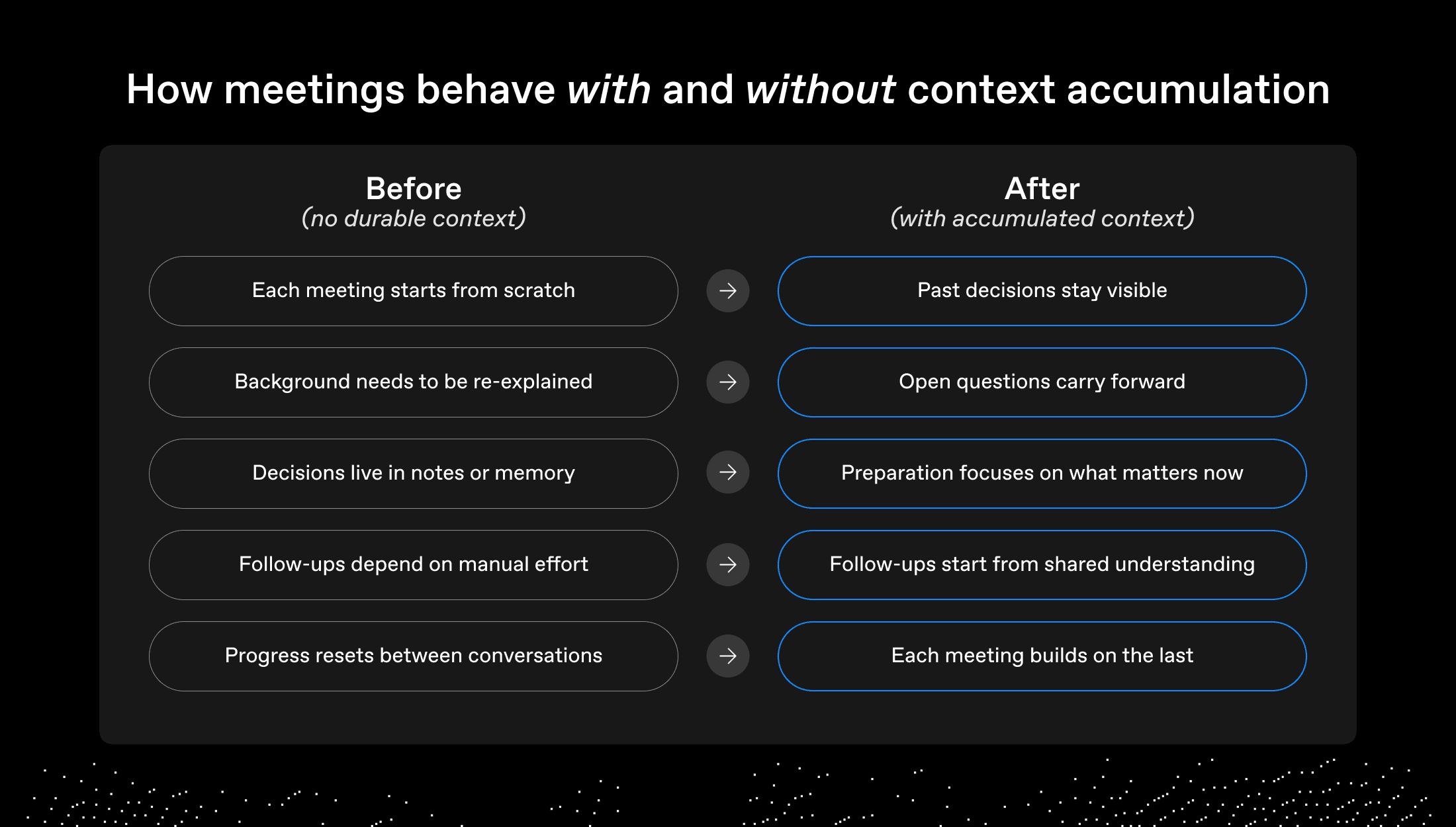
That gap shows up clearly in how people actually work. People skim summaries for highlights, meanwhile, decisions and nuances resurface in later meetings because there’s no shared, evolving understanding of what’s already been agreed.
This is why transcription alone isn’t enough. A transcript records everything, but it doesn’t explain what matters. AI’s real value is in interpretation. It can identify decisions, highlight risks, track open questions, and connect related conversations over time. It turns raw conversation into structured understanding.
Capture vs continuity
Most AI meeting tools optimise for capture
Records a single meeting well
Produces transcripts and summaries
Treats each meeting as a standalone event
AI applied as a system creates continuity
Connects related meetings over time
Carries decisions and open questions forward
Surfaces relevant context automatically
Turns conversations into inputs for ongoing work
When AI is applied only at the level of capture, meetings still behave like isolated events. When it’s applied at the level of interpretation and connection, meetings start to function as part of a larger system. That’s the shift that changes how preparation, follow-up, and execution actually work.
This shift isn’t unique to meetings. In software development, a recent MIT Technology Review piece has described a move away from one-off AI interactions toward what’s called “context engineering,” where systems are designed around the information they already have rather than the prompts they receive. That same lens helps explain why meetings matter so much in knowledge work.
The Meeting Context Flywheel
💡 The Meeting Context Flywheel defined
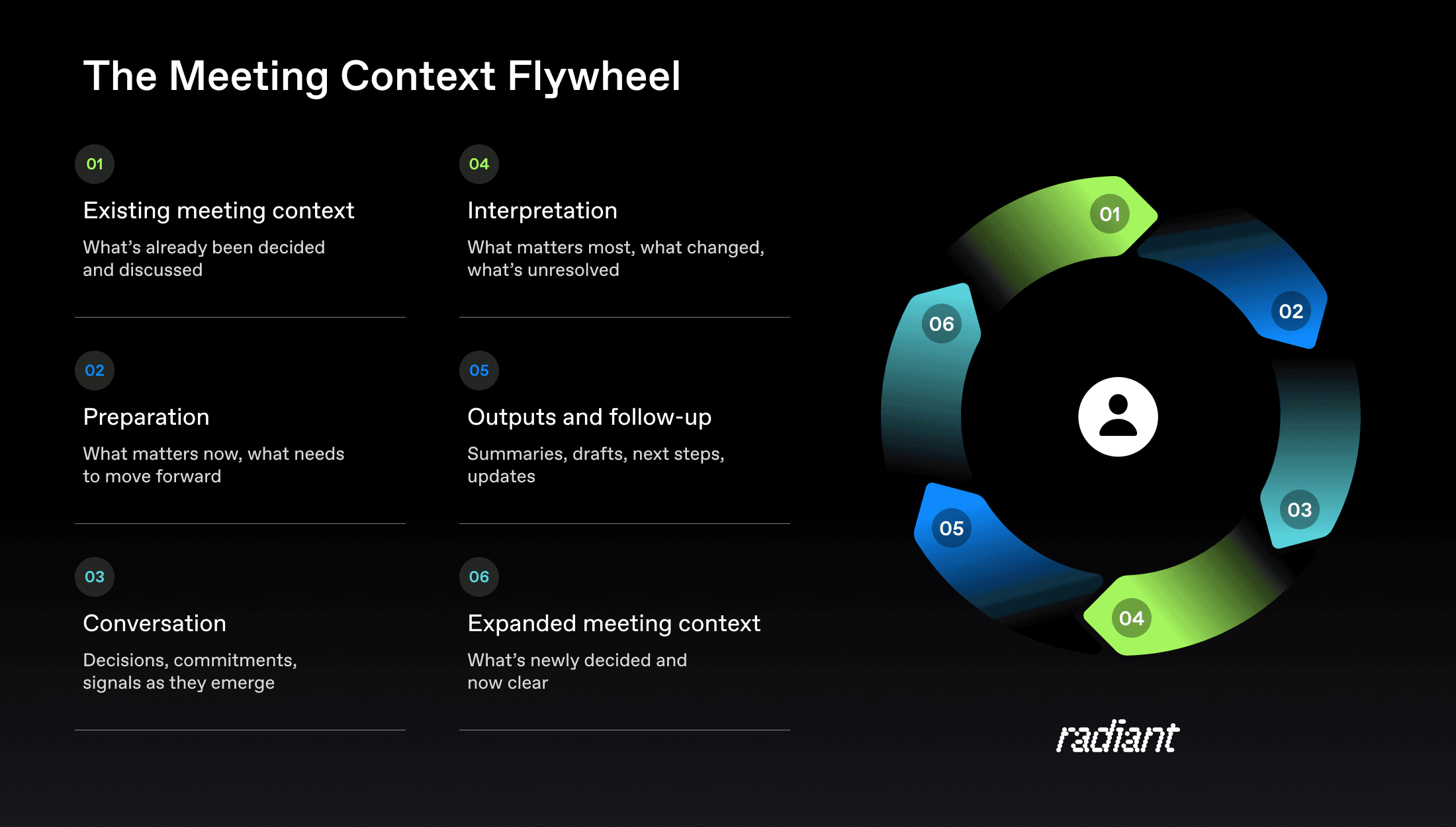
The Meeting Context Flywheel describes how meetings improve over time when AI captures and carries forward work context across preparation, conversation, and follow-up. Each meeting feeds the next by preserving decisions, open questions, and intent, giving AI the context it needs to support increasingly specific and meaningful work.
Large language models become more capable as they’re given richer, more recent, and more relevant information. The same is true for AI at work. For AI to move beyond generic tasks and support highly specific work, it needs context. And the most valuable work context rarely lives in documents or task lists. It lives in meetings.
Meetings are where intent is clarified, decisions are negotiated, and priorities change. That makes them the richest and most fragile source of work context most teams have.
How the Meeting Context Flywheel works
This pattern isn’t unique to meetings. Even though 64% of teams rate AI’s productivity impact as high, research suggests its benefits grow as usage matures. That mirrors how meeting context compounds over time, rather than delivering value in a single interaction.
The key shift with the flywheel system is that context doesn’t reset after each meeting. It accumulates and becomes more useful over time. Each part of the flywheel strengthens the next.
How AI changes what each meeting stage looks like
When AI is applied across meetings, preparation, conversation, and follow-up all change in distinct ways. What’s key is how these stages connect, and how little friction it takes to move from one to the next.
Before the call: getting oriented fast
For many teams, meeting prep still depends on memory, scattered notes, or a last-minute skim of the calendar invite. When meetings are frequent, ad hoc, or involve people outside the organization, that approach isn’t enough. By the time the call starts, context is uneven and momentum is already fragile.
Meeting AI changes this by making orientation fast and cumulative. Instead of relying on memory, teams can quickly see the decisions and open questions that matter for this call. The context for the meeting is already there, without requiring someone to hunt for it.
This also shifts what good preparation looks like. Rather than reading everything, the most valuable prep becomes clarifying direction. Why does this meeting matters now? What needs to move forward? What outcome would make the conversation successful? When AI brings the surrounding context into view, those questions are easier to answer in minutes, not hours.
During the call: staying focused on what matters
During a meeting, teams are often juggling competing demands. Keep the conversation moving. Make decisions. Stay aligned. Capture what matters for later. Under pressure, something usually gives.
Traditionally, that tradeoff shows up in note taking. Either someone tries to write everything down and falls behind, or notes get simplified to the point where nuance is lost. The meeting feels clear in the moment, then fuzzy afterward.
AI changes this dynamic by taking pressure off capture and putting focus back on the conversation. Its role during the call isn’t to direct discussion or interrupt the flow. It’s to quietly identify the moments that shape what happens next.
Decisions, commitments, risks, and unresolved questions often surface naturally in conversation, but they’re easy to miss or misinterpret in real time. When those signals are preserved as they emerge, teams don’t have to reconstruct meaning later. What mattered is already clear.
After the call: turning talk into progress
The point where most meetings fail isn’t during the conversation. It’s after the call ends.
Without support, follow-up relies on manual effort. Someone rewrites notes. Someone sends an update. Someone creates tasks. That work often happens late, inconsistently, or not at all, which is why momentum slips so easily between meetings.
AI changes this by reducing the gap between conversation and action. Instead of starting follow-up from scratch, teams can turn what was discussed into structured outputs immediately. Summaries, drafts, updates, and next steps become starting points for work, not extra admin layered on top.
When this stage works well, the output of one meeting directly shapes the next.
What durable AI meeting systems get right
Most AI meeting tools work the first few times people try them. The difference between systems that stick and systems that quietly disappear isn’t capability. It’s fit.
The systems that last share a few common traits. They adapt to existing behavior rather than trying to correct it. That distinction matters more than most feature comparisons.
They don’t change how people behave in meetings
One of the fastest ways to weaken a meeting is to make people self-conscious. When participants feel observed or managed, the conversation shifts. People explain more than they need to. They hold back uncertainty. They default to safer language instead of honest discussion.
This shows up clearly with some recording-first tools. When a visible bot joins a client call, people often adjust how they speak. They recap things that were already agreed. They avoid open disagreement.
This tradeoff between convenience and conversation quality is why some teams actively avoid meeting bots altogether and look for approaches that don’t require anything to join the call. You’ve likely seen this play out in practice, especially in client-facing or high-stakes meetings.
Durable systems avoid this by fading into the background. They capture what matters without interrupting the flow or requiring people to change how they run meetings. The meeting stays human, which is especially important in client-facing, sales, or high-stakes conversations where trust and tone matter as much as content.
They surface signal, not noise
Capturing everything isn’t the same as capturing what matters. Many teams using tools like Otter or Fireflies have experienced this firsthand. A full transcript exists, but no one reads it. A long summary gets skimmed, then forgotten.
Even well-designed notetaker tools like Granola can fall into this trap if the output isn’t structured around decisions, commitments, risks, and open questions.
Systems that last focus on signal. They highlight the moments that actually shape what happens next, instead of producing exhaustive records. This is why many teams still rely on simple one-page notes, decision logs, or short recaps, even when they have advanced tooling available. Signal beats completeness every time.
They reduce work instead of moving it around
A common failure mode across many AI meeting tools is shifting effort rather than removing it. Notes still need to be rewritten into emails. Action items still need to be turned into tasks. Updates still need to be drafted for clients or stakeholders.
Some teams use Fireflies or Otter to capture meetings, then manually translate the output into Slack updates, project plans, or follow-up emails. The AI helped record the meeting, but the work of turning conversation into action still sits with the human.
Durable systems shorten that distance. Teams use AI to draft a client recap immediately after a call, turn meeting discussion into a first pass at a project plan, or generate a follow-up email that’s ready to send. Human effort goes into refinement, not translation.
When that gap closes, meetings stop creating hidden admin work later in the day.
They fit into the tools teams already use
Adoption often fails not because a tool isn’t powerful, but because it lives in the wrong place. If meeting output requires people to log into yet another workspace, it quickly gets ignored.
Teams export notes into Notion or Google Docs. Others move summaries into Slack, Linear, Jira, or email. The more steps that sit between the meeting and where work actually happens, the more likely context gets lost.
Durable AI meeting workspaces minimize those steps. Insights flow directly into the tools teams already rely on. Email drafts, documents, task trackers, and chat threads. Low friction beats perfect structure every time.
They get better with use
Finally, systems that last improve over time. As more meetings pass through them, they develop a better understanding of recurring topics, decision patterns, and where work tends to stall.
But there's a deeper shift happening too. Your team's most valuable knowledge doesn't live in documents or wikis. It lives in the conversations where strategy is debated, client needs are understood, and hard calls get made. When that context is captured and carried forward, it becomes an enduring asset that AI can reference and build on. Over months and years, this accumulated understanding turns into something competitors simply can't replicate. Their AI tools start from zero. Yours starts from everything your team has learned together.
Radiant follows this approach, focusing on context that compounds across preparation, conversation, and follow-up, so each meeting feeds the next.
What this changes for teams that live in meetings
When meetings are treated as a source of durable context rather than isolated events, a few things start to change.
Less time is spent re-explaining decisions
Teams don’t have to revisit the same background or relitigate choices across multiple calls. What was decided stays visible.AI becomes more useful over time
As context accumulates, AI can support more specific work. Drafts get closer to usable. Follow-ups get clearer. Suggestions reflect how the team actually operates.Preparation feels lighter, not heavier
People spend less time hunting for information and more time deciding direction. A few minutes of orientation replaces pages of catch-up.Follow-up work shrinks
Conversations turn into drafts, updates, and next steps without as much manual translation. Meetings stop creating hidden admin later in the day.Meetings start to feel connected
Each call builds on the last. Progress carries forward instead of resetting. The system supports momentum instead of relying on memory.
"I want my athletes to feel like anything they tell me, I remember and follow up with them on. Even small details about their lives." — Sara, Performance Coach
That’s what it looks like when meeting context is allowed to compound.